4.4 Assumption in a cloud scenario
The deployment of the solution in a cloud environment has no impact from the viewpoint of virtualization, since the logic and virtual components do not change. This type of deployment changes the assumptions that can be made. The cloud solutions have a known availability, and this availability is usually unique for virtual processing components, for communication links, and for immutable virtual components. The cloud context has an impact on the communication links between the component and the rest of the software solution. Unlike deployment in an enterprise controlled environment, the availability of the communication link between the component C1 and the kernel applications A1 and A2 or the report generator A3 may be lower. By basing on the same software solution, the assumption that the server part of the solution is deployed on Microsoft Windows Azure can be made. The availability of virtual components dependent on components A1, A2, A3 and D1 is therefore 99.9 %. . The availability of communication link may be lower; an assumption is made of an availability of 99 % . Series virtual components then move from 0.8806 to 0.998 (0.999 x 0.999) for components A1, A2 and D1. The availability of the virtual components parallel to component A3 is calculated as follows:
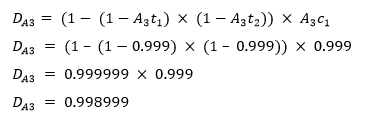
Availability of the solution is adjusted, and is calculated as follows:
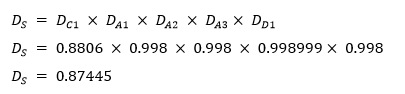 The same solution deployed using cloud technologies shows an improvement of the availability in the order of 69.96 %, from 0.6117 to 0.8744. No changes to the architecture were made. The design of the solution must be compatible with the mode of deployment for cloud technologies.
Contents · 24/26
- Design for High Availability
- Introduction
- 1 Hardware Abstraction
- 1.1 Isolating the levels of abstraction
- 1.2 Physical components category
- 1.3 Virtual Layer
- 1.4 Abstraction of virtual components
- 1.5 Characteristics of virtual components
- 2 High Availability Mecanisms
- 2.1 Framework for analysis of the mechanisms and assumptions
- 2.2 Public interface of a solution
- 2.3 Risk Control
- 2.4 One approach: duplication
- 2.5 Limits of replication of immutable virtual components
- 3 Evaluation of downtime risks
- 3.1 Dependency hierarchy
- 3.2 Bottlenecks
- 3.3 Method for calculating availability
- 3.4 Methodology of analysis
- 4 Evaluation in real cases
- 4.1 Basic software solution
- 4.2 Analysis without assumptions
- 4.3 Evaluation with addition of availability assumptions
- 4.4 Assumption in a cloud scenario
- Conclusion
- References